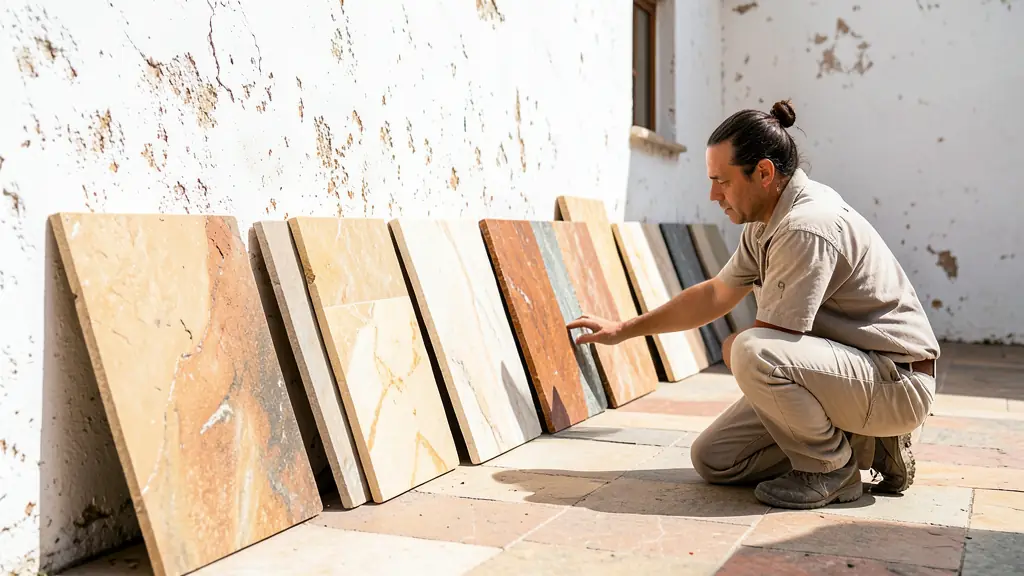
Looking for natural stone tiles for a floor, wall or patio? SlateTiles.co.za is a free quote service. You fill in one form and we pass your request to independent stone and tile suppliers in your area, who quote you directly. Slate, sandstone, travertine and quartzite all behave differently, so say what you want and where it goes. There is no fee and no obligation. We do not sell tiles, we do not do any installation, and we never give prices.
Slate, sandstone, travertine and quartzite compared
Every stone has its own look and its own habits. Knowing the differences helps you ask the right questions.
- Slate: fine-grained, dense and low in porosity. The natural cleft surface grips well underfoot. Colours run from black and charcoal to rustic tones with copper, gold, rust and green.
- Sandstone: warm, sandy colours and a softer, more porous body. It suits dry covered areas but marks and stains more easily.
- Travertine: a banded, creamy stone with natural pits that are usually filled. It is sensitive to acids, so kitchen spills and acid cleaners can etch it.
- Quartzite: very hard and often sparkly. It handles heat, wear and weather well.
Most suppliers also offer limestone and granite. Ask to see a real sample, because colour varies between batches.
Where natural stone tiles work best
Indoors, natural stone tiles suit entrance halls, lounges, kitchens and bathrooms. Outdoors, natural stone tiles outdoor projects such as stoeps, patios, braai areas and pool surrounds need a stone that copes with sun, rain and foot traffic. A cleft or textured surface is safer when wet.
Climate matters. Frost on the Highveld and in the Free State can crack a porous stone that stays damp. Coastal salt air can mark soft stone. Summer storms in Gauteng and KZN push water across open paving, so the choice of surface and the falls both count. If you want one look from the lounge to the patio, ask suppliers which stones suit both.
Many people searching for natural stone tiles South Africa want a matching indoor and outdoor floor. That is possible when the finish and slip rating are right for each area.
Laying and sealing: what to check
Natural stone is heavier and less uniform than ceramic, so the fixing matters as much as the stone.
- Use a flexible, polymer-modified adhesive and a solid bed with no voids under floor tiles.
- Ask whether the tiles are calibrated (even thickness) or uncalibrated. Uncalibrated stone needs a thicker adhesive bed and a skilled tiler.
- Allow movement joints, especially across large floors and outdoors.
- Give outdoor areas a slight fall so water runs off.
- Check for efflorescence, the white salt bloom that rises from damp screeds.
Seal most stones with an impregnating sealer. Clean with a pH-neutral cleaner and keep acid products away from travertine and slate.
What affects your quote
Suppliers quote on your details, not on a standard list. These points shape the answer:
- The type of stone and its origin. Some is quarried in southern Africa and some is imported.
- The tile size, thickness and finish, such as honed, brushed or cleft.
- The area in m², plus an allowance for cuts and breakage.
- Delivery distance, pallet weight and how easy it is for a truck to reach the site.
- Supply only, or supply and install, and whether sealer and adhesive are included.
The more you tell the suppliers, the closer the quote will be to the final job.
Comparing natural stone tiles quotes
Natural stone varies from batch to batch, and prices move with imports, stock and transport. When quotes arrive, check:
- Exact product: the colour, finish, size and thickness, and whether it is calibrated, so every quote is for the same thing.
- Quantities: the price per m², box, pallet or piece, and how much is allowed for cuts and breakage.
- Stock and delivery: in stock or on order, delivery to site or collection, and any off-loading charge.
- VAT and returns: whether VAT is included, how long the price holds and whether unopened boxes can go back.
What to include in your request
- State the area in m² and add a note for cuts and wastage.
- Name the stone you prefer, or say which stones you want compared.
- Say whether the tiles go indoors, outdoors or both.
- Mention the finish you want and whether grip matters.
- Give the town or suburb for delivery and say if you need installation.
Frequently asked questions
Which natural stone is best for a South African home?
Do natural stone tiles need sealing?
Can I use the same stone indoors and outdoors?
How does the quote process work?
Natural Stone Tiles by province
- Natural Stone Tiles Gauteng
- Natural Stone Tiles Mpumalanga
- Natural Stone Tiles North West
- Natural Stone Tiles Limpopo
- Natural Stone Tiles Northern Cape
- Natural Stone Tiles Free State
- Natural Stone Tiles KwaZulu-Natal
- Natural Stone Tiles Eastern Cape
- Natural Stone Tiles Western Cape
Natural Stone Tiles by city and town
- Natural Stone Tiles in Johannesburg
- Natural Stone Tiles in Pretoria
- Natural Stone Tiles in Centurion
- Natural Stone Tiles in Midrand
- Natural Stone Tiles in Sandton
- Natural Stone Tiles in Randburg
- Natural Stone Tiles in Roodepoort
- Natural Stone Tiles in Krugersdorp
- Natural Stone Tiles in Randfontein
- Natural Stone Tiles in Germiston
- Natural Stone Tiles in Boksburg
- Natural Stone Tiles in Benoni
- Natural Stone Tiles in Kempton Park
- Natural Stone Tiles in Alberton
- Natural Stone Tiles in Vanderbijlpark
- Natural Stone Tiles in Vereeniging
- Natural Stone Tiles in eMalahleni (Witbank)
- Natural Stone Tiles in Middelburg
- Natural Stone Tiles in Secunda
- Natural Stone Tiles in Mbombela (Nelspruit)
- Natural Stone Tiles in Rustenburg
- Natural Stone Tiles in Brits
- Natural Stone Tiles in Klerksdorp
- Natural Stone Tiles in Potchefstroom
- Natural Stone Tiles in Polokwane
- Natural Stone Tiles in Tzaneen
- Natural Stone Tiles in Lephalale
- Natural Stone Tiles in Kimberley
- Natural Stone Tiles in Kathu
- Natural Stone Tiles in Upington
- Natural Stone Tiles in Bloemfontein
- Natural Stone Tiles in Welkom
- Natural Stone Tiles in Sasolburg
- Natural Stone Tiles in Durban
- Natural Stone Tiles in Pinetown
- Natural Stone Tiles in Pietermaritzburg
- Natural Stone Tiles in Richards Bay
- Natural Stone Tiles in Newcastle
- Natural Stone Tiles in Ladysmith
- Natural Stone Tiles in Gqeberha (Port Elizabeth)
- Natural Stone Tiles in East London
- Natural Stone Tiles in Kariega (Uitenhage)
- Natural Stone Tiles in Cape Town
- Natural Stone Tiles in Bellville
- Natural Stone Tiles in Paarl
- Natural Stone Tiles in Stellenbosch
- Natural Stone Tiles in George
- Natural Stone Tiles in Worcester