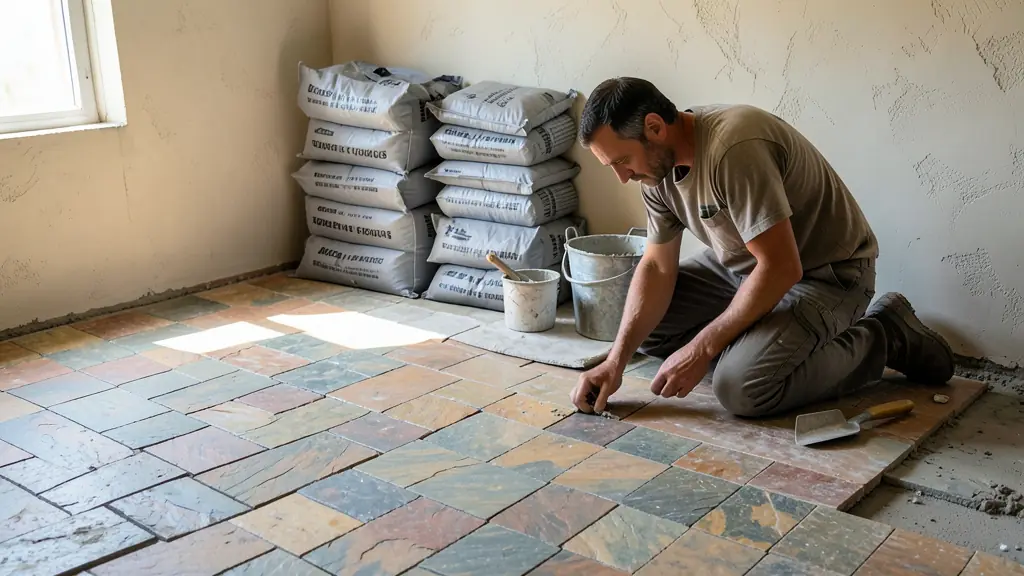
The right tile adhesive decides whether a slate floor stays flat and solid for years. SlateTiles.co.za is a free quote service. Tell us the tile type, the area in m² and whether the job is a floor, wall or outdoor area. We pass your request to independent suppliers in your area, who quote you directly for adhesive and grout. There is no fee and no obligation. We do not sell adhesive and we do not lay tiles. You simply compare what suppliers offer.
Types of tile adhesive and grout
Cement-based adhesive is sold as a powder that you mix with water. People often ask for tiling cement, but plain cement is not the same thing. Tiling adhesive is a blended product made to grip both the tile and the surface under it.
- Standard adhesive suits small ceramic wall tiles on a sound surface.
- Flexible, polymer-modified adhesive suits floors, outdoor areas and large tiles.
- Rapid-set adhesive is used when the floor must be walked on sooner.
- Tiling grout comes cement-based in many colours, or epoxy-based for wet and stain-prone areas.
Choosing adhesive for slate
Most slate jobs call for a flexible adhesive for slate. Natural slate can curl slightly, and floors and outdoor areas move with heat, cold and damp. A polymer-modified product copes with that movement.
- Uncalibrated slate has uneven thickness and needs a thicker adhesive bed.
- Calibrated slate has an even thickness and can use a thinner bed.
- Dark slate looks best with grey or charcoal grout. White grout shows as a harsh line.
- Some adhesives can stain light stone, so ask your supplier about natural stone.
What to check before tiling
Good adhesive cannot fix a poor base. Check these before work starts:
- The screed must be cured, flat and clean. Damp screeds can cause efflorescence (white salt bloom).
- Use a solid bed with no voids under floor and outdoor tiles. Hollow spots crack under load.
- Back-butter large or uneven slate tiles as well as combing the bed.
- Leave movement joints and fill them with flexible sealant, not rigid grout.
- Outdoor areas need falls (slope) so water runs off.
Follow the mixing and open time instructions on the bag.
What affects your adhesive quote
Suppliers usually ask for the following:
- The area in m² and the tile size.
- Whether the tiles are slate, other stone, porcelain or ceramic.
- Floor, wall, outdoor or wet area.
- Grout type and colour, and whether you want movement joint sealant.
- Supply only or supply and install, plus delivery to your site.
Suppliers can usually estimate the number of bags once they know the area and tile type.
Comparing tile adhesive and grout quotes
Natural stone varies from batch to batch, and prices move with imports, stock and transport. When quotes arrive, check:
- Exact product: the colour, finish, size and thickness, and whether it is calibrated, so every quote is for the same thing.
- Quantities: the price per m², box, pallet or piece, and how much is allowed for cuts and breakage.
- Stock and delivery: in stock or on order, delivery to site or collection, and any off-loading charge.
- VAT and returns: whether VAT is included, how long the price holds and whether unopened boxes can go back.
What to include in your request
- State the area in m² and the tile size.
- Say if the tiles are slate, other stone, porcelain or ceramic.
- Mention whether the job is a floor, wall or outdoor area.
- Say if the slate is calibrated or uncalibrated.
- State your delivery address and when you need the bags.
Frequently asked questions
Can I use ordinary cement instead of tiling cement for slate?
How much tile adhesive do I need?
Which tiling grout suits slate floors?
How long before I can walk on tiles and grout them?
Tile Adhesive and Grout by province
- Tile Adhesive and Grout Gauteng
- Tile Adhesive and Grout Mpumalanga
- Tile Adhesive and Grout North West
- Tile Adhesive and Grout Limpopo
- Tile Adhesive and Grout Northern Cape
- Tile Adhesive and Grout Free State
- Tile Adhesive and Grout KwaZulu-Natal
- Tile Adhesive and Grout Eastern Cape
- Tile Adhesive and Grout Western Cape
Tile Adhesive and Grout by city and town
- Tile Adhesive and Grout in Johannesburg
- Tile Adhesive and Grout in Pretoria
- Tile Adhesive and Grout in Centurion
- Tile Adhesive and Grout in Midrand
- Tile Adhesive and Grout in Sandton
- Tile Adhesive and Grout in Randburg
- Tile Adhesive and Grout in Roodepoort
- Tile Adhesive and Grout in Krugersdorp
- Tile Adhesive and Grout in Randfontein
- Tile Adhesive and Grout in Germiston
- Tile Adhesive and Grout in Boksburg
- Tile Adhesive and Grout in Benoni
- Tile Adhesive and Grout in Kempton Park
- Tile Adhesive and Grout in Alberton
- Tile Adhesive and Grout in Vanderbijlpark
- Tile Adhesive and Grout in Vereeniging
- Tile Adhesive and Grout in eMalahleni (Witbank)
- Tile Adhesive and Grout in Middelburg
- Tile Adhesive and Grout in Secunda
- Tile Adhesive and Grout in Mbombela (Nelspruit)
- Tile Adhesive and Grout in Rustenburg
- Tile Adhesive and Grout in Brits
- Tile Adhesive and Grout in Klerksdorp
- Tile Adhesive and Grout in Potchefstroom
- Tile Adhesive and Grout in Polokwane
- Tile Adhesive and Grout in Tzaneen
- Tile Adhesive and Grout in Lephalale
- Tile Adhesive and Grout in Kimberley
- Tile Adhesive and Grout in Kathu
- Tile Adhesive and Grout in Upington
- Tile Adhesive and Grout in Bloemfontein
- Tile Adhesive and Grout in Welkom
- Tile Adhesive and Grout in Sasolburg
- Tile Adhesive and Grout in Durban
- Tile Adhesive and Grout in Pinetown
- Tile Adhesive and Grout in Pietermaritzburg
- Tile Adhesive and Grout in Richards Bay
- Tile Adhesive and Grout in Newcastle
- Tile Adhesive and Grout in Ladysmith
- Tile Adhesive and Grout in Gqeberha (Port Elizabeth)
- Tile Adhesive and Grout in East London
- Tile Adhesive and Grout in Kariega (Uitenhage)
- Tile Adhesive and Grout in Cape Town
- Tile Adhesive and Grout in Bellville
- Tile Adhesive and Grout in Paarl
- Tile Adhesive and Grout in Stellenbosch
- Tile Adhesive and Grout in George
- Tile Adhesive and Grout in Worcester