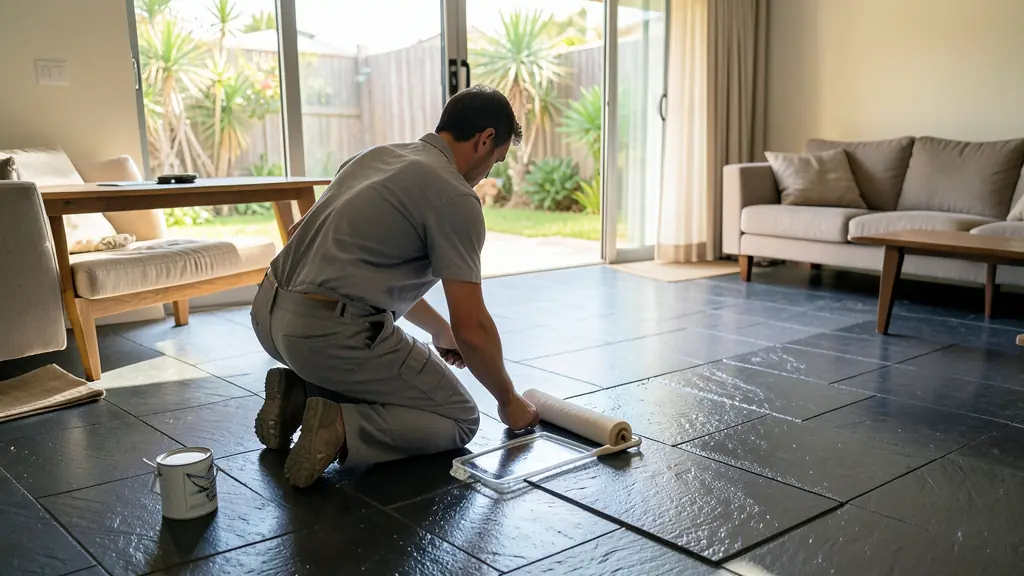
Looking for a tile sealer for slate, stone or other tiles? SlateTiles.co.za is a free quote service. Tell us what you want to seal, the area in m² and whether it is indoors or outdoors. We pass your request to independent suppliers in your area, who quote you directly. There is no fee and no obligation. We do not sell sealer and we do not do the sealing ourselves. You simply compare what suppliers offer, with advice on products, coats and how often to reseal.
Types of tile sealer
Most products fall into two groups. An impregnating (penetrating) sealer soaks into the stone and leaves the surface looking natural. A topical or enhancing sealer works at or near the surface and deepens the colour, which suits black and charcoal slate.
- A slate sealer is usually water-based or solvent-based. Solvent-based products often give a stronger colour effect.
- A grout and tile sealer protects cement grout lines, which are porous even when the slate is dense.
- Some products are made for glazed tiles only and do not suit natural stone.
Where tile sealer is used
Slate is dense and low in porosity, but it should still be sealed. Sealer helps keep out oil, wine, soap and dirt. Common places are:
- Kitchen and bathroom floors, where spills and splashes are regular.
- Entrance halls and passages with heavy foot traffic.
- Stoeps, patios and braai areas, where an outdoor tile sealer must handle rain, dust and UV.
- Pool surrounds, where the sealer should keep the natural cleft grip.
Coastal salt air and strong Highveld sun both shorten the life of a sealer coat.
What to check before sealing
Sealing goes wrong when the floor is not ready. Check these first:
- Slate and grout must be fully dry. Sealing over trapped moisture can leave white patches.
- Efflorescence (white salt bloom) must be cleaned off and given time to stop returning.
- Old sealer or wax may need stripping so the new coat can soak in.
- Test a spare tile or hidden corner, because enhancers change the colour.
A tile sealer waterproof against splashes is not a waterproofing membrane. Showers and wet areas still need proper waterproofing under the tiles. Clean with pH-neutral products afterwards, never acid.
What affects your sealer quote
Suppliers will ask a few things before they quote:
- The total area in m² and the number of coats.
- Stone type and finish: natural cleft, honed or tumbled.
- Indoor or outdoor, and how much sun and rain the area gets.
- Supply only, or supply and application by a tiler or sealing specialist.
- Pack size and delivery distance, especially to outlying areas.
Photos of the surface help a supplier recommend the right product.
Comparing tile sealer quotes
Natural stone varies from batch to batch, and prices move with imports, stock and transport. When quotes arrive, check:
- Exact product: the colour, finish, size and thickness, and whether it is calibrated, so every quote is for the same thing.
- Quantities: the price per m², box, pallet or piece, and how much is allowed for cuts and breakage.
- Stock and delivery: in stock or on order, delivery to site or collection, and any off-loading charge.
- VAT and returns: whether VAT is included, how long the price holds and whether unopened boxes can go back.
What to include in your request
- State the area to be sealed in m².
- Say whether the tiles are slate, other stone or ceramic.
- Mention the finish: natural cleft, honed or tumbled.
- Say if the area is indoors, outdoors or around a pool.
- Note any white marks, old sealer or damp problems.
Frequently asked questions
How often should slate be resealed?
Does sealer change the colour of slate?
Can I seal slate that has gone white?
Do I need a different sealer for grout?
Tile Sealer by province
- Tile Sealer Gauteng
- Tile Sealer Mpumalanga
- Tile Sealer North West
- Tile Sealer Limpopo
- Tile Sealer Northern Cape
- Tile Sealer Free State
- Tile Sealer KwaZulu-Natal
- Tile Sealer Eastern Cape
- Tile Sealer Western Cape
Tile Sealer by city and town
- Tile Sealer in Johannesburg
- Tile Sealer in Pretoria
- Tile Sealer in Centurion
- Tile Sealer in Midrand
- Tile Sealer in Sandton
- Tile Sealer in Randburg
- Tile Sealer in Roodepoort
- Tile Sealer in Krugersdorp
- Tile Sealer in Randfontein
- Tile Sealer in Germiston
- Tile Sealer in Boksburg
- Tile Sealer in Benoni
- Tile Sealer in Kempton Park
- Tile Sealer in Alberton
- Tile Sealer in Vanderbijlpark
- Tile Sealer in Vereeniging
- Tile Sealer in eMalahleni (Witbank)
- Tile Sealer in Middelburg
- Tile Sealer in Secunda
- Tile Sealer in Mbombela (Nelspruit)
- Tile Sealer in Rustenburg
- Tile Sealer in Brits
- Tile Sealer in Klerksdorp
- Tile Sealer in Potchefstroom
- Tile Sealer in Polokwane
- Tile Sealer in Tzaneen
- Tile Sealer in Lephalale
- Tile Sealer in Kimberley
- Tile Sealer in Kathu
- Tile Sealer in Upington
- Tile Sealer in Bloemfontein
- Tile Sealer in Welkom
- Tile Sealer in Sasolburg
- Tile Sealer in Durban
- Tile Sealer in Pinetown
- Tile Sealer in Pietermaritzburg
- Tile Sealer in Richards Bay
- Tile Sealer in Newcastle
- Tile Sealer in Ladysmith
- Tile Sealer in Gqeberha (Port Elizabeth)
- Tile Sealer in East London
- Tile Sealer in Kariega (Uitenhage)
- Tile Sealer in Cape Town
- Tile Sealer in Bellville
- Tile Sealer in Paarl
- Tile Sealer in Stellenbosch
- Tile Sealer in George
- Tile Sealer in Worcester