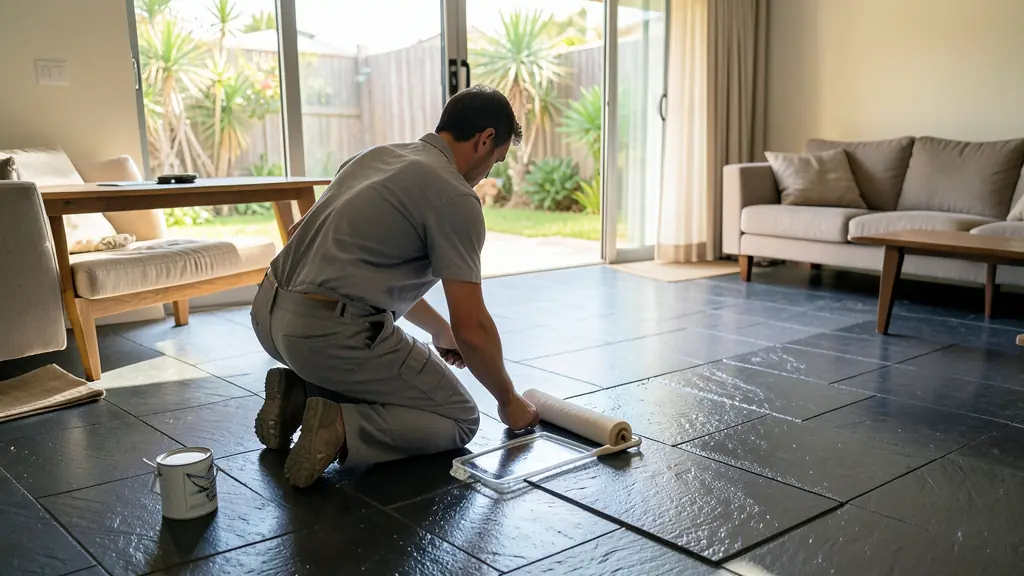
Calculate how many litres of sealer your slate floor, patio or pool surround needs from the area, surface texture and number of coats, and how often to reseal.
What changes how far sealer goes
Sealer coverage is given on the tin in m² per litre, and it can vary by a factor of three on slate. A honed or smooth slate absorbs little and a litre can cover 15 m² or more. Natural cleft (riven) slate has a textured face with more surface area, so a litre covers about 8–12 m². Old, weathered or very porous slate, and rough uncalibrated slate, can drink sealer at 5–6 m² per litre on the first coat.
The second coat goes further because the stone is already partly filled; the calculator assumes it covers about 50% more than the first. If the tin gives a coverage figure, enter it instead of the preset.
Impregnating or topical sealer?
- Impregnating (penetrating) sealers soak into the stone and leave the surface looking natural. They protect against water and oil stains, don't make the floor slippery and suit outdoor areas and pool surrounds.
- Colour enhancers are impregnators that darken the slate to a permanently "wet look".
- Topical (surface) sealers form a film that gives a sheen or gloss. They wear in walkways and can peel outdoors, and some make slate slippery when wet, so they are mostly used indoors on low-traffic areas.
How often to reseal slate
As a rule of thumb, impregnated indoor floors need resealing every 3–5 years, outdoor patios every 2–3 years, and pool surrounds and showers every 1–2 years. Topical sealers in walkways may need a fresh coat every year. A simple test: drip water on the slate. If it darkens the stone within a few minutes instead of beading, it is time to reseal. Clean thoroughly and let the slate dry for at least 24–48 hours first.
Frequently asked questions
How much sealer do I need for 50 m² of slate?
Should slate be sealed before grouting?
Does sealer make slate slippery?
Products and services this helps with
- SP-01Tile Sealer
- SV-02Slate Tile Sealing
- SV-03Slate Cleaning and Restoration
- ST-03Outdoor Slate Tiles
- SV-06Slate Pool Surrounds
- ST-02Slate Floor Tiles
- SV-05Slate Patio and Paving Installation
- RF-06Roof Restoration
More calculators and guides
- T-01Slate tile calculatorFloor or wall area in m², number of tiles and boxes, with a cutting allowance and an optional budget.
- T-02Tile adhesive and grout calculatorBags of tile adhesive by trowel size or bed thickness, and kilograms of grout from tile size, joint and depth.
- T-04Roof slate and tile calculatorRoof area from the plan and pitch, slates or roof tiles needed, battens, nails and the weight on the roof.
- T-05Roof pitch calculatorConvert rise and run to degrees, percent and ratio, with the pitch factor, rafter length and roof area.
- T-06Slate weight and delivery calculatorHow heavy your slate order is, how many pallets, and whether it fits in a bakkie or needs a truck.
- T-07Which slate? SelectorPick where the slate goes and see the thickness, finish, adhesive, joint and sealer that suit it.