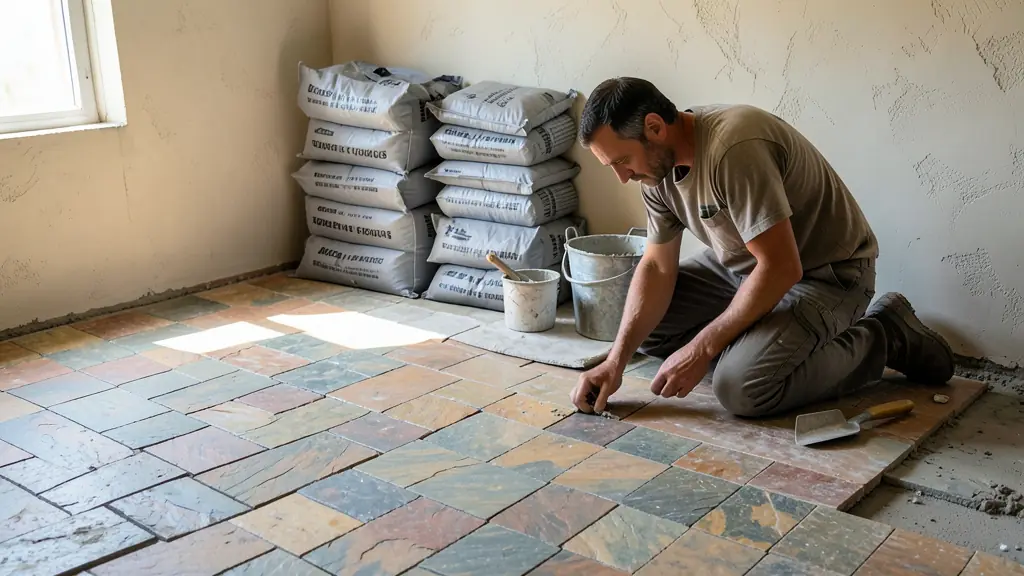
Work out how many bags of tile adhesive and how much grout you need for slate and natural stone tiles, from the area, tile size, joint width, trowel and bed thickness.
How much adhesive slate needs
Slate uses more adhesive than ceramic or porcelain. Calibrated slate (even thickness) is laid on a notched-trowel bed, and the bag usage depends on the notch size. Uncalibrated slate varies in thickness by several millimetres, so it is laid on a thick bed that takes up the difference, and it can use twice as much adhesive or more.
For natural stone, most adhesive makers and tilers recommend back-buttering: a thin skim of adhesive on the back of each tile as well as the combed bed on the floor. It gives full contact, which matters outdoors and in wet areas, where hollow spots let water collect and tiles crack or lift. The calculator adds about 1 kg/m² for it.
The usage figures are typical for cement-based tile adhesive. Products differ, so check the coverage on the bag and use that if it is given.
The grout formula
Grout fills the joints, so the amount depends on the joint's width and depth and on how many metres of joint there are per m², which goes up as tiles get smaller:
kg per m² = (tile length + tile width) ÷ (tile length × tile width) × joint width × joint depth × 1.6
All sizes are in millimetres, and 1.6 is the approximate density of mixed cement grout in kg per litre. The joint depth is normally the thickness of the tile. For uncalibrated slate, use the average thickness. The calculator adds 10% for mixing and clean-up waste.
Choosing the trowel and joint
- Tiles up to 200 mm: 6 mm notch. Up to 300 mm: 8 mm. Up to 450 mm: 10 mm. Larger tiles: 12 mm, with back-buttering.
- Calibrated slate is usually laid with 3–5 mm joints. Uncalibrated and riven slate looks and works better with 6–10 mm joints.
- Outdoors, around pools and on suspended slabs, use a flexible (polymer-modified) adhesive and grout, and leave movement joints at the edges and every few metres as the adhesive maker specifies.
- Seal porous slate before grouting so the grout doesn't stain the face. See the sealer calculator.
Frequently asked questions
How many bags of tile adhesive do I need per m²?
How much grout do I need for slate tiles?
Can I use normal tile adhesive for slate?
Why does uncalibrated slate need so much more adhesive?
Products and services this helps with
- SP-02Tile Adhesive and Grout
- SV-01Tilers for Slate Tile Installation
- ST-02Slate Floor Tiles
- ST-03Outdoor Slate Tiles
- SV-07Slate Bathroom Tiling
- ST-07Slate Wall Tiles
- SP-03Tilers Tools
- SV-04Stone Cladding Installation
More calculators and guides
- T-01Slate tile calculatorFloor or wall area in m², number of tiles and boxes, with a cutting allowance and an optional budget.
- T-03Slate sealer calculatorLitres of sealer for the area, surface texture and number of coats, and how often to reseal.
- T-04Roof slate and tile calculatorRoof area from the plan and pitch, slates or roof tiles needed, battens, nails and the weight on the roof.
- T-05Roof pitch calculatorConvert rise and run to degrees, percent and ratio, with the pitch factor, rafter length and roof area.
- T-06Slate weight and delivery calculatorHow heavy your slate order is, how many pallets, and whether it fits in a bakkie or needs a truck.
- T-07Which slate? SelectorPick where the slate goes and see the thickness, finish, adhesive, joint and sealer that suit it.